For weeks, Kainat, 21, and her younger sister Maria, 19, were missing without a trace.
Their family feared the worst after the two Christian sisters disappeared in April 2026, leaving behind only unanswered questions and growing anxiety.
More than a month later, they would finally be reunited with their parents after police uncovered what investigators described as an alleged human trafficking and forced marriage network operating in Sindh.
According to police records, a raid carried out on 7 May 2026 led to the registration of First Information Report (FIR) No. 92/2026 at New Faujdari Police Station in Shikarpur under Sections 371-A, 371-B and 34 of the Pakistan Penal Code, together with provisions of the Prevention of Trafficking in Persons Act, 2018.
Investigators alleged that several young women had been unlawfully confined after being brought to Sindh through deception, false promises of employment or marriage, or abduction.
Among those rescued during the operation were four Christian women, including Kainat and Maria.
Although they had been rescued, the sisters were initially transferred to Sukkur Prison while legal proceedings relating to the wider investigation continued.
On 11 May 2026, The EDGE Foundation became aware of the case through media reports and immediately began efforts to identify the Christian victims and locate their families.
During those enquiries, the Foundation established contact with the sisters’ younger sibling, Laiba, who explained that Kainat and Maria had been missing since April after travelling to Sindh with a family acquaintance named Iram.
According to the family, Iram had persuaded the sisters to travel by offering employment opportunities and discussing a possible marriage proposal.
Recognising the urgency of the situation, The EDGE Foundation arranged legal assistance, obtained court documents, coordinated with local lawyers and provided financial support to enable the family to travel from Punjab to Shikarpur to participate in the legal proceedings and meet the sisters.
On 13 May 2026, Laiba formally requested legal assistance on behalf of the family.
Working alongside local legal representatives, the Foundation pursued the necessary legal remedies to secure the sisters’ release.
Those efforts resulted in Kainat and Maria being granted bail on 19 May 2026, allowing them to return safely to their family after weeks of uncertainty.
Later, on 27 May 2026, Maria became involved in a separate legal matter linked to the wider investigation. Legal representation continued, and she was also granted bail.
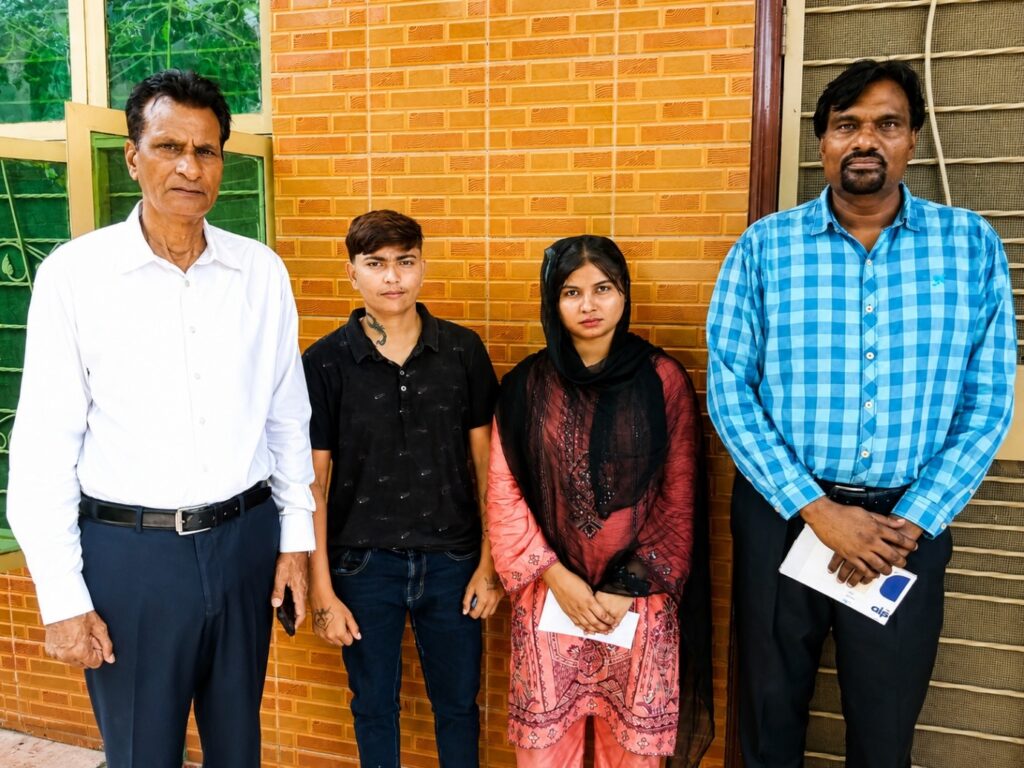
When the sisters met representatives of The EDGE Foundation on 15 June 2026, accompanied by their father Naseer and sister Laiba, they spoke publicly for the first time about the ordeal they said they had experienced.
According to Kainat, she and several other young women were first taken to Karachi before being transported to a remote location where they were allegedly pressured into forced marriages.
She alleged that the women were threatened with weapons, deprived of their mobile phones and personal belongings, confined for nearly two weeks and provided with only limited food.
The sisters also described being subjected to intimidation and psychological abuse while being prevented from leaving.
According to Kainat, an elderly man eventually helped several of the women escape.
However, instead of immediately returning home, the sisters were taken into police custody as part of the wider criminal investigation into the alleged trafficking network.
The sisters further alleged that women from different religious backgrounds and nationalities were also present at the location, leading them to believe that the operation involved a much larger trafficking network extending across provincial boundaries.
They have called for a thorough investigation into those responsible, protection for survivors and witnesses, and stronger safeguards to prevent other young women from experiencing similar abuse.
Kainat and Maria’s case highlights the methods that alleged traffickers are accused of using to target vulnerable young women through false promises of employment or marriage before transporting them far from their homes.
It also demonstrates the importance of rapid legal intervention and coordinated support once victims are located. Without access to legal representation, financial assistance and family support, many vulnerable victims may struggle to navigate complex legal proceedings before they can safely return home.
Today, Kainat and Maria are back with their family and beginning the difficult process of rebuilding their lives. Although the emotional impact of their experience continues, their safe return offers hope that, through effective law enforcement, legal advocacy and continued support for survivors, victims of human trafficking can find protection and the opportunity to rebuild their futures.