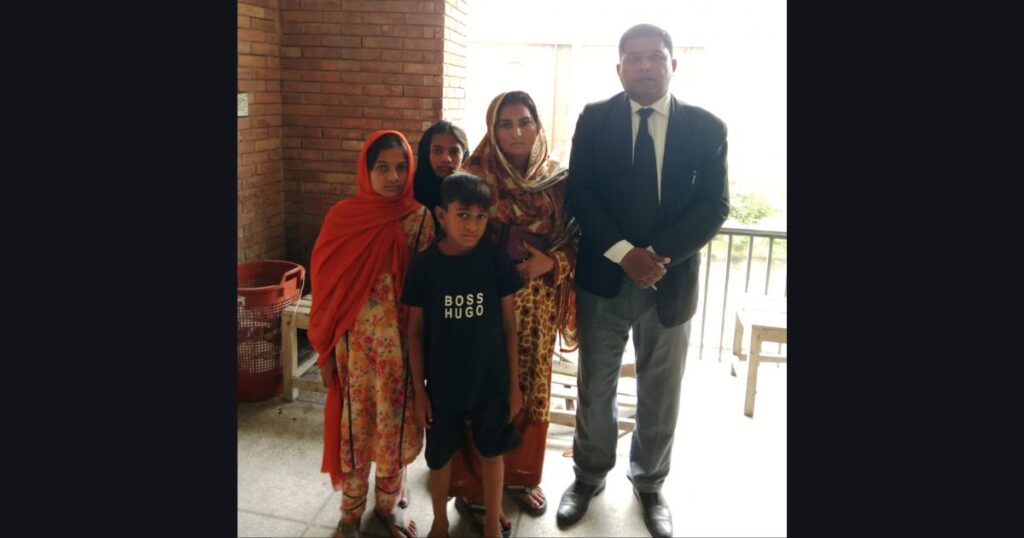
For Anita, every day since her husband disappeared has brought greater fear, financial hardship and uncertainty.
Sajid Masih, a Christian hospital worker from Faisalabad, has been missing since 29 May 2026, after reportedly leaving his workplace to meet a man with whom he had an ongoing financial dispute.
His wife says she has repeatedly approached the police and other authorities, but has received no clear information about where her husband is or what may have happened to him.
With limited financial resources and no ability to continue paying private legal fees, Anita approached The EDGE Foundation on 6 July 2026 seeking free legal assistance and support in recovering her husband.
Sajid worked as a ward boy at Allied Hospital in Faisalabad, helping to support his wife and family through modest employment.
According to Anita, on the day of his disappearance, Sajid told her that he was going to meet Muhammad Arif, a retired soldier and landlord, at Arif’s residence.
She says the meeting was intended to resolve a long-running dispute concerning money allegedly borrowed by the family.
That was the last communication Anita received from her husband.
Sajid did not return home, and his mobile phone reportedly became unreachable. His whereabouts have remained unknown since that day.
According to Anita, her family had borrowed PKR 765,000 from Muhammad Arif during a period of financial difficulty.
She alleges that during the transaction, Arif obtained Sajid’s signatures and thumb impressions on blank promissory notes. She claims those documents were later completed in a way that falsely showed Sajid owed PKR 2 million in connection with the alleged purchase of a piece of land.
Anita maintains that the original loan had been repaid in instalments.
To make those repayments, Sajid reportedly entrusted his cheque book to Muhammad Arif. According to Anita, individual cheques were signed only when each instalment became due.
However, she alleges that while the cheque book remained in Arif’s possession, he retained three or four unsigned blank cheques without Sajid’s knowledge.
Although the cheque book was later returned after the repayments were completed, Anita claims Arif attempted to use the retained cheques to demand further money.
She says Sajid was pressured to sign the cheques but refused, maintaining that he owed no additional amount.
According to Anita, the disagreement continued until Arif approached Sajid at Allied Hospital and asked him to meet so the dispute could be resolved.
On 29 May 2026, Sajid informed his wife that he was going to Arif’s residence to discuss the matter. He was not seen by his family again.
Following his disappearance, Anita contacted the police and submitted an application requesting immediate action to trace her husband.
On 31 May 2026, she personally appeared before the Capital City Police Officer in Faisalabad and submitted a written complaint in which she named Muhammad Arif as a person of concern.
According to Anita, she informed the authorities that Arif had previously threatened Sajid and was the last known person her husband intended to meet.
She also states that Muhammad Arif appeared before the police in connection with the complaint.
Despite this, Anita alleges that the authorities failed to carry out a prompt or effective investigation.
She says the police asked her to obtain CCTV footage from Allied Hospital, where Sajid had worked, rather than securing the footage themselves through their investigative powers.
Anita believes that gathering CCTV recordings, questioning relevant witnesses and tracing her husband’s movements should have been the responsibility of the investigating authorities.
She has accused the police of adopting a negligent and biased attitude, resulting in delays and a failure to make meaningful progress in locating Sajid.
After receiving no satisfactory response, Anita sought assistance from a private lawyer.
A petition was subsequently filed before the court of Rana Sohail, Additional Sessions Judge in Faisalabad, seeking the registration of an FIR and further legal action concerning Sajid’s disappearance.
The matter remains pending before the court, with the next hearing reportedly scheduled for 9 September 2026.
However, Anita says she was only able to pay a small amount towards the lawyer’s initial expenses and cannot afford the continuing costs of legal representation and court proceedings.
Her financial hardship has worsened since Sajid’s disappearance because the family has also lost the income he earned from his hospital employment.
After being referred by a local pastor, Anita approached The EDGE Foundation and requested free legal representation.
The Foundation documented her account and arranged a meeting with a lawyer on 9 July 2026 to review the case and pursue the available legal remedies.
Legal assistance will focus on seeking Sajid’s recovery, supporting the pending court proceedings and pressing for an impartial investigation into the circumstances of his disappearance.
The case raises serious concerns about the possible unlawful deprivation of Sajid’s liberty, the alleged failure of law enforcement authorities to act promptly and claims involving financial fraud, coercion and misuse of blank promissory notes and cheques.
It has also placed severe emotional and financial pressure on Anita, who continues to search for answers while trying to manage the household without her husband’s income.
For the family, the immediate priority is to determine whether Sajid is safe and secure his return home.
Until his whereabouts are established, Anita remains caught between fear and hope, relying on the courts and legal intervention to obtain the investigation she believes should have begun immediately after her husband disappeared.
Sajid’s case illustrates the importance of timely police action in missing-person cases, particularly when there is evidence of prior threats or an unresolved dispute. It also highlights how poverty can prevent vulnerable families from accessing justice unless free legal representation is made available.